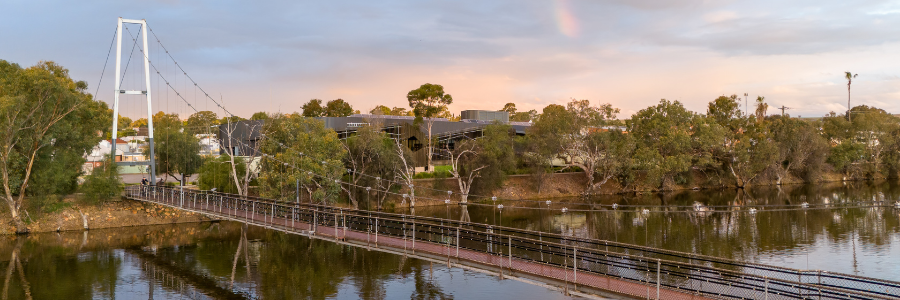
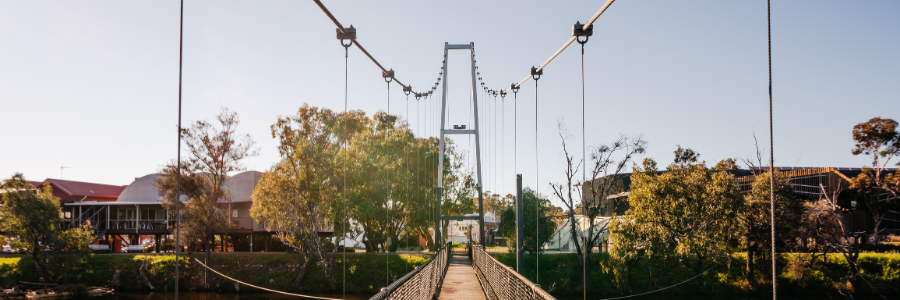
Spanning the Avon River in Northam, the Suspension Bridge is one of Australia’s longest pedestrian suspension bridges. Built in 1975, it has become an iconic landmark and a much-loved way to experience the river up close.
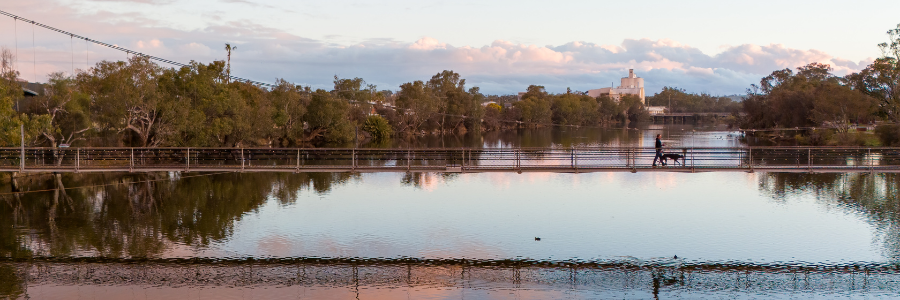
Approach the bridge via the surrounding walk trails and pause to read the sign above the entry, which shares a few facts and figures about its construction. Take your time as you cross, this is the perfect vantage point to enjoy tranquil river views, native vegetation, and the gentle rhythm of life along the Avon.
Just downstream, across the river from the Northam Visitor Centre, is the feeding area for Northam’s famous white swans. Introduced to Western Australia in 1896, the swans have thrived in the Avon River, with Northam recognised as the only natural breeding ground for white swans in Australia. Watching them glide across the water is a highlight for visitors of all ages.
From the bridge, continue your walk through Bernard Park along the riverbank. Enjoy a picnic or barbeque, let the children play in the nearby playground, or follow the path to the next bridge to complete a scenic circuit showcasing the natural beauty of the town.
Each August, Northam also comes alive as the starting point of the Avon Descent, a 133-kilometre white-water adventure race that draws competitors and spectators from across the country.
Just a two-minute walk from the bridge through Bernard Park brings you to the Northam Visitor Centre, where you can plan the rest of your stay, discover local attractions, and perhaps pick up a souvenir postcard of this iconic crossing.
Avon River Suspension Bridge
Facts & Figures
Community Connection & Awareness
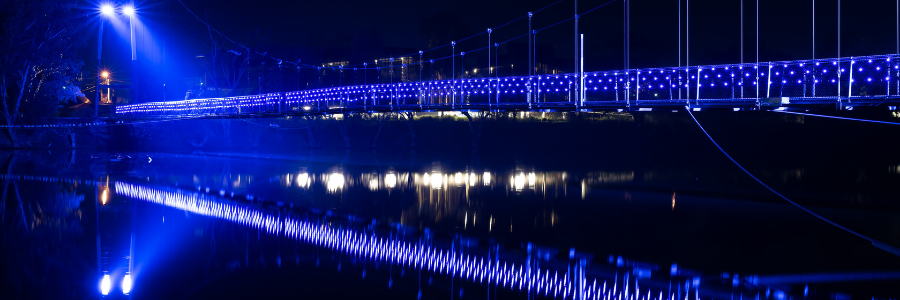
Beyond its engineering significance, the Avon River Suspension Bridge has evolved into a powerful communication and community awareness asset. In recent years, the bridge has been illuminated in different colours to recognise important dates, events, and causes, helping spark conversation and reflection within the community.
Notable examples include red lighting for Dyslexia Awareness in October 2025 (as part of the Light it Red campaign) and blue lighting to mark Australia Day 2026, demonstrating how this landmark continues to connect people, not just physically, but socially and symbolically.
Community groups and organisations interested in registering a new lighting display are encouraged to contact: records@northam.wa.gov.au
Avon Bridge (Gairdner St.)
This bridge is the third to be erected at this site. The original 1858 convict crossing built of sawn timber stringers and driven piles was severely damaged by the 1862 floods and eventually replaced in 1900 by a more sustainable structure. The current bridge was built in 1939 and improved in 1942, 1966 and again in 1980. “The Mill” stands as one of Northam’s important icons.

"The Mill"
The Flour Mill stands as one of Northam's icons at this historic crossing.
A commercial multistoried flour mill has always existed on this site, with the original building having been expanded. In 1867, Tom Wilding began operations by installing a steam drive mill, to improve quality and to compete with imported flour from South Australia. Thomas and Co (1910) continued upgrading the facilities and introduced bulk handling of grain. Today, Weston Milling maintains a modern production line within the shell of these tall historic buildings.
Interesting Facts
If you stand on the centre of the Avon Bridge and look one way up the river and then look in the opposite direction you will think you are looking at two different rivers.
One direction has many islands and channels and is the best surviving example of how the river looked before European settlement. These islands are sanctuaries for fauna and are major bird breeding areas - the expanse of water offering protection from predators.
In the opposite direction is the Northam Town Pool which was created by the construction of the Northam Weir which was proposed in 1895 and first constructed in 1907-08. This body of water is also an important bird sanctuary - especially in summer.
Land clearing for agriculture significantly changed the Avon River environment by increasing the salt content of the water. While the river once provided safe drinking water for humans and was even transported to the Goldfields, it is now unfit for human consumption and only seasonally fit for stock water. Surprisingly, much of the local flora and fauna have survived these environmental changes. Consequently, the river remains a vital environmental, educational, social, recreational, cultural, and economic asset.
Peel Terrace Bridge
This bridge, built in 1955, was the first prestressed concrete bridge to be built in Western Australia. Recruited from the UK, engineer Gratton Wilson was an expert in the emerging technology of prestressed concrete bridge building. This new technology reduced demand on natural forests for timber beams and planks. The components were designed, developed, and manufactured in Northam's Main Roads pre-casting yards.
Updated 04.03.26